Allendale Co-op Timeline
1904 to 1939
From humble beginnings in a wash house in 1874, the 'Allendale Industrial and Provident Society' grew rapidly to become a central part of life in the dale.
Part One of this timeline tells the story of the first 70 years of this store; its staff, premises and activities in the dale from 1874 until the outbreak of the Second World War. This period brought much upheaval in England, which was reflected in the daily lives, sales and personalities of Allendale's Co-op.
In association with the Allen Valleys Local History Group. Research and text by Jared Dunn. The early photographs have been colourised.
1904-1913
New century, new premises
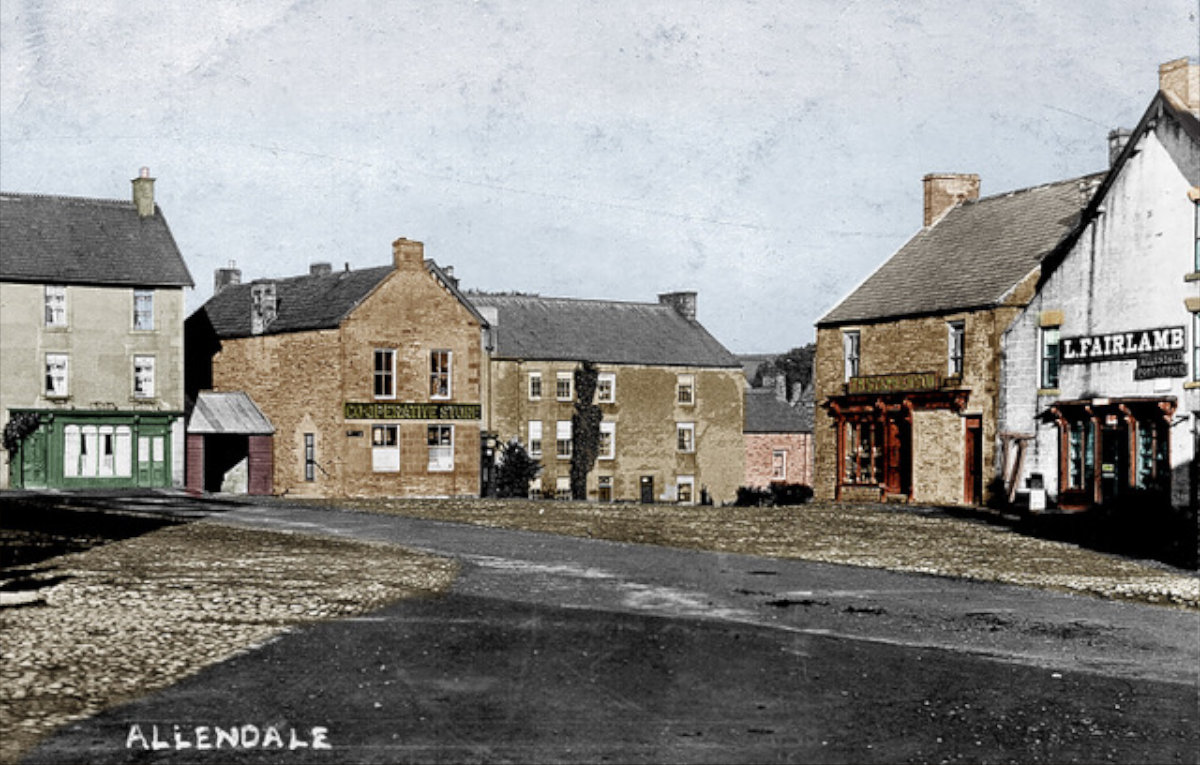
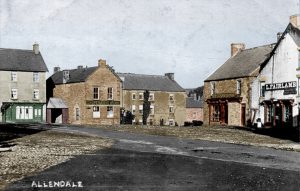
Allendale Square, c.1913 © Jared Dunn
1905: January
There is no email in 1899 – the Society's members are called to a general meeting via postcards that are mailed to each of them. A meeting is called to discuss ‘the covering of the lane’, a construction of a wooden building to house goods between the two properties they now own. Thoughts are turning to how to expand operations beyond Curtain House, which has served as the store for over 25 years.
1906
Members who shop at the Society's store receive dividend tokens, or ‘checks’, with every purchase. These are discs made from tinned copper or iron bearing the name of the society and a monetary value.
Tokens are being used in Allendale by 1900 before being phased out for paper chits by 1919. A purchase of 6d meant a customer was given a 6d ‘check’. A customer saved these until the end of the half-year, when the ‘checks’ were handed in exchange for the dividend payment. A rare £1 Allendale metal ‘check/token’ was found in a Shilburn field (formerly used as a local rubbish tip) by local boy, John Batey, in the 1950s.
1906: 19th November
Across a laneway, south of the Curtain House store, is a grocery store run by JW Robson. Moving forward to 2025 – that laneway still exists as the entryway to the Co-op's back warehouse, and that former JW Robson building is owned by the Co-op. In 2025, it is called Kirton House and houses a butcher's shop (ground floor) and flats (above).
In the early hours of 19 November 1906, fire breaks out at JW Robson's shop. It is subsequently described by the Hexham Courant as the ‘biggest ever known in the dale’. Against the 'sombre grey of the early winter dawn there shot out from each of the three storeys of the premises great tongues of flame. The sensation was most tremendous when, with a mighty crash, the roof fell in.'
1909: May
After his shop is gutted by fire and rebuilt over the next two years, John W Robson enters into lengthy negotiations with the Society. The Society is already keen to expand its existing premises.
The Society considers rebuilding their current store, but votes 14:9 in 1909 to purchase JW Robson's store for £1,500 instead as additional premises. JW Robson emigrates to Canada.
The new building becomes the Society's grocery department until 1990 and is a butcher's shop in 2025.
1909: June
Allendale Industrial & Provident Society now owns three adjacent properties; a manager's house (West View), Curtain House (the existing store), and the new store (former JW Robson's grocery store).
JW Robson’s grocery shop transitions to become the Society's grocery store, which means Curtain House can be repurposed into specialised departments.
The first drapery department is installed in 1909 offering fabric, dressmaking materials, ready-made clothing and hats. Administered by Mrs Mary French, it is open 8.30am-7pm daily and until 9pm on Saturdays.
By 1913, 'a boot shop (is) laid out in the Drapery department’. It stocks a wide range of metal clog irons – which are hammered into the soles of local wooden clogs that are ubiquitous around the dale.
1914-1923
Great War and recovery
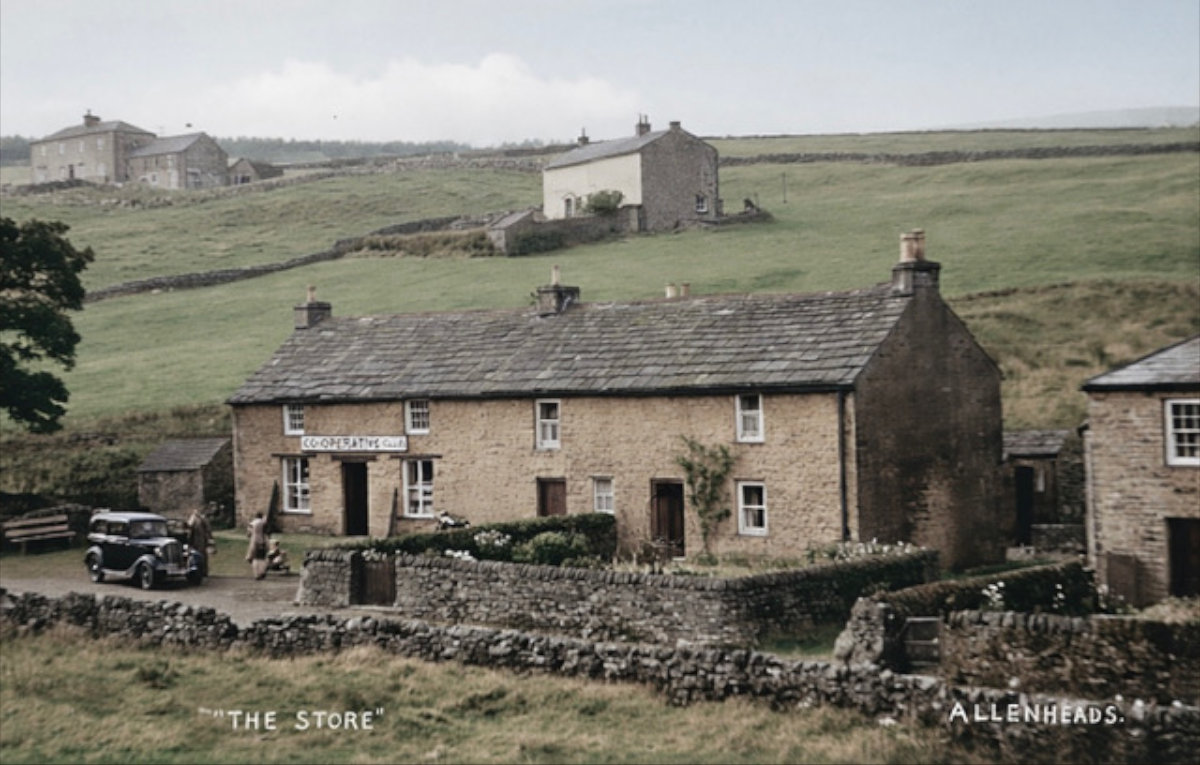
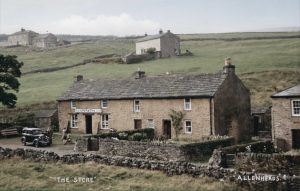
Co-op Branch Store, Allenheads c.1930 © Allendale Co-operative Society Ltd
1914: October
Shortly after war breaks out, a members' meeting is held and votes to donate '£10 to the War Fund’. In October 1914 Belgium is overrun and £2-12-0 is donated to the Belgian Distress Fund. Refugees start arriving in England, including many who are housed in Allendale. Another £1 is donated to wounded soldiers and sailors in hospitals.
Everyday village life continues – the first bacon slicing machine (a costly £38) is ordered in 1914. On 31st December 1915 the committee protests ‘against the lighting of bonfire in the Market Square and (it) being dangerous to the Society’s property’. Then as in 2025, the prevailing New Year wind obviously blew from the west.
Rationing is introduced in February 1918 when the Society acts just ahead of national restrictions by allocating 1/2lb of tea and sugar per family.
1915: 20th February
It is clear from the many deliveries up the dale that establishing a branch shop in Allenheads might be profitable. On 20th February 1915, a majority vote approves to ‘rent a shop at Allen heads and approach Messrs Forster & take their shop at £10 per year’.
This initial rental is successful and in 1916 the Allenheads branch building is successfully purchased. JH Whitfield – who has previously worked in the Allendale Town store – is appointed manager at £1 per week (£86 in 2025).
1915: October
The funeral of Mr JJ Allison takes place; he had resigned as store manager after 35 years in 1914. Herbert Milburn is selected from among 65 applicants to replace him. Herbert had commenced work at the Society's store as an apprentice many years before and lived on Arnison Terrace.
The Co-op is active in representing its employees by asking for exemptions for from military service. William Glenwright, son of the former Co-op cartman was called up aged 18 in 1916 and – after representation – was granted a temporary exemption for 7 months.
1917: January
It is agreed to send a letter of sympathy to the Shields of Park Gates on the death of their son, Robert. He is listed on St Cuthbert’s lychgate. Sadly, store employee William Glenwright, who has previously been granted an exemption, is called up and subsequently killed on the Western Front.
Less than a year after attending his father’s funeral in Allendale, JJ Allison's son James is killed on the Somme, aged 23. By 1917, store manager Herbert Milburn, is called up as has the single store hand at Allenheads. This leads to real difficulties in operating the Society's stores.
1918: 16th February
The Society agrees to take over Mr. Dixon’s butchering business on Shield Street for £100. Mr Lee is appointed as butcher at £3 p/week.
The business proves a challenge; in May 1921, owing to financial losses, Mr Lee is given notice.
1923
Times are increasingly tough across the country culminating in the General Strike of 1926. In common with many employers, the Society's committee agrees a 15% reduction in wages for its employees.
None of this helps the struggling butchery business, but the building – which is a hairdresser in 2025 – is bought outright by the Society in 1925 from Mr Arnison for £850.
1921: September
There are brighter prospects in the sports area. The Society has hired two fields behind Arnison Terrace in order to graze their horse but this land is little used in winter. In 1921, the committee advises Percy Edgar (secretary of Allendale's 'football association') that the local footballers can use one of the fields for their games to 'keep it in order'.
1924-1933
Centre of dale life
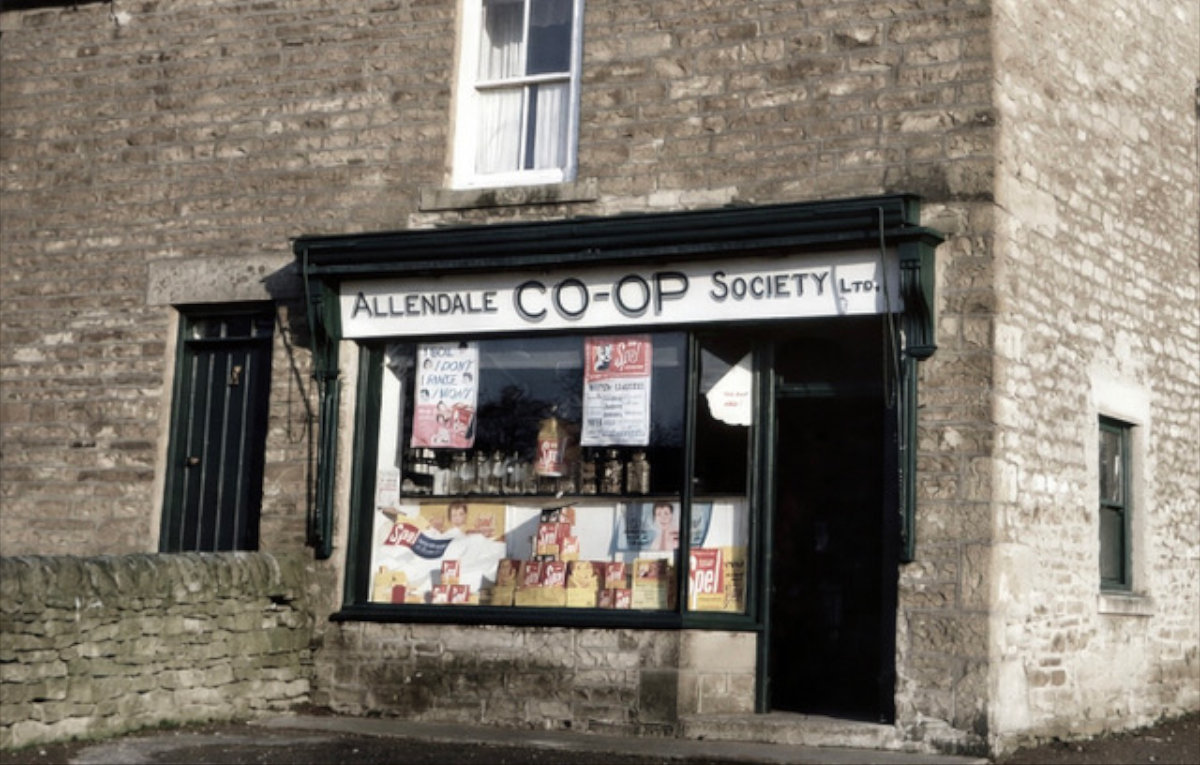
Co-op Branch Store, Catton c.1961 © Allendale Co-operative Society Ltd
1927: 8th February
The Society buys the two fields behind Arnison Terrace from the Rose & Crown inn. Given their proximity to the village the ‘Big Field’ and ‘Small Field’ are much in demand for recreation events, shows and sporting activities. The Society often obliges; the Flower Show Committee sub-lets them in 1926 for a fee of £2.2.0.
Football continues to be played on the Store fields by both men and women footballers. Rent of £6 (£246 in 2025) per winter season is charged. Livestock and football don't always mix. In October 1934, the footballers complain that a ‘cattle wagon’ has cut up the pitch.
1927: 6th June
It is 'agreed to approach Mr Robson regarding W Craig’s Shop at Catton.’ The Society subsequently buys this former general store for £450 as their new Catton branch shop. The Society now has main stores in Allendale Town and branches in both Allenheads and Catton.
1927
Modernisation comes in fits and starts. The butchery premises on Shield Street is rebuilt by Newman's builders (including the wheatsheaf 'Labor and Wait' logo still visible in 2025).
Meanwhile, at the main store in Allendale Town it is agreed that any decision to install a new-fangled refrigerator should be left to 'lie over for a while’. A similar proposal in install electricity is also set aside.
1931
The Society donates land for the parish to build the village's public toilets on the site where they exist today.
1933
In August, a set of counter scales is purchased from WJ Avery for the huge sum of £150. These are regularly tested by external auditors to ensure accuracy.
In November, it is reported that delivery man, W.Dixon, ‘was in the habit of smoking cigarettes whilst serving customers’. It is agreed that he be ‘interviewed’ at the next committee meeting.
That same month, there is a sign that the Society needs to consider the dilapidated old manager’s house at West View. The tenants (the Misses Foster) ask for a reduction in rent owing to ‘the bad state the house is in’.
1934-1939
New store for a new age
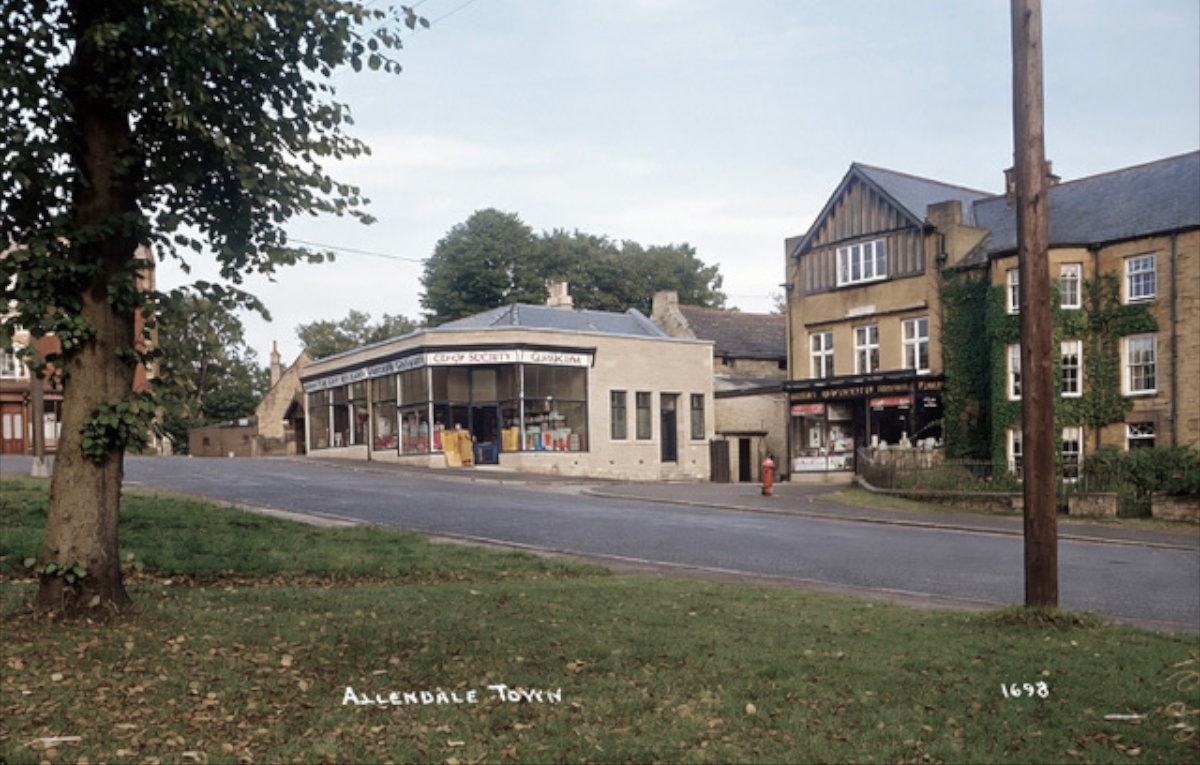
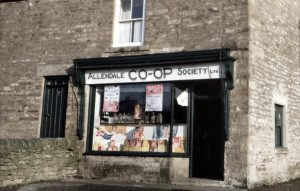
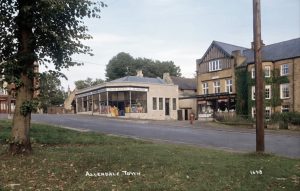
Co-op Central Store, Allendale Town c.1938 © Jared Dunn
1934
In the 1930s, the Society's store takes shape as the external building we know in 2025.
Mr Hetherington is engaged as architect and proposes demolishing both Curtain House and West View to replace them with a single modern building.
The separate 'bottom store' grocery building (Kirton House in 2025) is to be retained but upgraded with the installation of electricity.
1935: 8th March
There are six applications in answer to an advertisement for a 'boy of 14 years of age’. An unsuccessful candidate, William (Billy) Pringle is subsequently taken on as a bicycle delivery boy.
1935: June
The demolition of Curtain House and West View is underway. Sadly, there is a construction accident as stone is being carting away from the site;
Joseph Thompson of Catton Lane Foot is killed whilst using a horse and cart in the removal process.
Local builders, W&J Newman, build the new 'drapery buildings' in a 1930s style at a cost of £1552.8.9. These will become known as the 'top store' and 'middle store'.
1936: June
The new store buildings are opened in June 1936 by the president of the National Co-operative Congress, 61 years after the opening of the first Allendale Society store. He notes that the society originated with one employee and now employs 25 people. Similarly, that membership has grown from 300 in 1906 to 937 in 1936 with 90% of residences in the dale now being represented within its membership.
Mr Wallhead, the local chairman, summed up by asserting that; 'I question very much whether any society has a better history than the Allendale Society.'
1936: September
The turmoil of national and international events in the 1930s touches Allendale.
In September 1936, the Mayor of Jarrow writes to appeal for funds to support the protest march of unemployed men to London. Although the Society is regularly petitioned for assistance from regional and national bodies, it tends to focus on the local area instead so an appeal from the Jarrow Marchers is not supported. In 1938, the store similarly declines to donate to Spanish Civil War causes but did participate in the wider 'Milk for Spain' appeal. Shoppers purchase milk tokens which then support civilian relief efforts in that war-torn country.
1938
The haven of calm that is the drapery department is disrupted in 1938 when the manager reports that a windowpane in the department has been broken by a young man staying at the Dale hotel. He had apparently been hitting loose pebbles in the Market Square with a walking stick.
It is agreed by the committee to 'put in a new glass in and that the account be paid by the young man.’
1939: August
As war again approaches, the new store layout will look familiar to many who come to know the store until the 1960s.
The ‘bottom store’ is the main grocery where service is from behind a counter. Ascending central stairs leads one up to the hardware department where a wide range – from clothes props, to nails, to wellington boots – might be purchased.
Walking to the greengrocery means passing the Society office, where the manager and office staff are based.
The ‘middle store’ – a corner greengrocery within the new building – stocks a range of fresh goods – fruit, vegetables and baked goods. Glassware and tableware are stacked on adjacent shelves. Later it becomes the space to showcase furniture and radios.
Finally, the ‘top-store' – inaccessible at this time from the middle store, and so accessed via a separate external door – is the drapery. This is a peaceful department of rolled fabrics, various clothing items, boots and shoes.
There really is no need to leave Allendale to shop for more!
©Jared Dunn 2025